
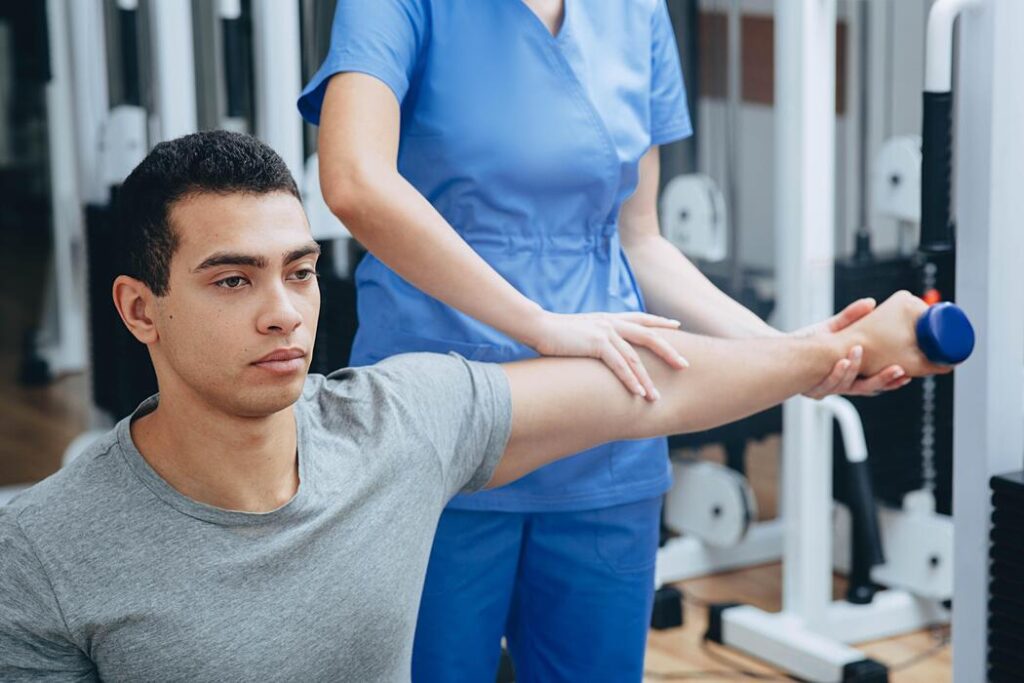
Quick Answer: “A muscle strain may need physical therapy when pain lasts more than a week or two, strength or movement remains limited, the injury keeps returning, or you cannot resume normal activity without symptoms. Physical therapy can identify the severity, rebuild strength, restore mobility, and guide a safer return to work, exercise, or sports.”
Muscle strains are easy to underestimate. You may feel a sudden pull during a workout, notice soreness after a long hike, or wake up the next day with a muscle that feels tighter and more painful than normal. Mild strains can improve with time and sensible activity changes, but others linger because the injured tissue has not regained its previous strength or tolerance.
The important question is not simply whether the muscle still hurts. You also need to consider how well it moves, how strong it feels, whether normal activities are returning, and what happens when you increase the load again.
If a strain is interfering with exercise, sports, work, or everyday movement, sports injury physical therapy in Phoenix can help determine what is limiting your recovery and create a structured plan for returning safely.
What is a muscle strain?
A muscle strain happens when muscle fibers or the tendon connected to the muscle are stretched beyond their current capacity. Strains can develop suddenly during a sprint, lift, jump, or awkward movement, or gradually through repeated overload.
Common strain locations include:
- Hamstrings
- Calves
- Quadriceps
- Groin Muscles
- Lower Back Muscles
- Shoulder Muscles
- Hip Flexors
A strain is different from ordinary post-workout soreness. Normal muscle soreness usually develops after unfamiliar exercise, affects a broader area, and improves steadily over several days. A strain is more likely to feel localized and may cause pain during specific movements, stretching, or muscle contraction.
How do you know how serious a muscle strain is?
The severity of a muscle strain depends on how much tissue was injured and how much function you lost. You do not need to diagnose the grade yourself, but understanding the general pattern can help you decide what to do next.
| Strain Pattern | What You May Notice | Typical Next Step |
| Mild | Local soreness, little strength loss, normal walking or daily movement | Reduce aggravating activity and monitor recovery |
| Moderate | More noticeable pain, weakness, swelling, or difficulty using the muscle normally | Evaluation and structured rehabilitation may help |
| Severe | Sudden intense pain, significant weakness, bruising, major loss of function | Seek prompt medical evaluation |
A mild injury should generally move in the right direction over time. If symptoms stay the same, worsen, or return each time you test the muscle, the recovery process may need more structure.
Early recovery after a muscle strain
The first goal after a muscle strain is to protect the injured area from repeated aggravation while maintaining comfortable movement when possible.
Early management may include:
- Reduce The Activity That Triggered The Injury
- Avoid Repeatedly Testing The Painful Movement
- Keep Gentle, Comfortable Movement In Your Day
- Use Compression Or Elevation When Swelling Is Present And Appropriate
- Avoid Aggressive Stretching Into Pain
- Monitor Changes In Strength, Swelling, And Function
Complete inactivity is not always necessary for a mild strain. Muscles generally need gradual exposure to movement and load as they recover.
The challenge is knowing when and how much to progress.
When can a muscle strain improve without physical therapy?
A mild strain may improve without formal physical therapy when symptoms steadily decrease, normal movement returns, and you can gradually resume activity without the pain returning.
Home management may be reasonable when:
- Pain Is Mild And Clearly Improving
- There Is Little Or No Swelling
- Normal Walking And Daily Tasks Are Comfortable
- Strength Feels Close To Normal
- Range Of Motion Is Returning
- Activity Can Be Increased Gradually Without A Flare
The key word is improving.
If every few days bring noticeable progress, you may simply need time and sensible load management. If recovery stalls, the same muscle keeps getting injured, or you cannot progress beyond low-level activity, an evaluation becomes more useful.
Signs the strain may need physical therapy
Physical therapy becomes more valuable when the injury is affecting function, not improving as expected, or repeatedly returning.
Common reasons to seek help include:
- Pain Lasts More Than A Week Or Two Without Clear Improvement
- Strength Is Noticeably Reduced
- You Cannot Move Through Your Normal Range Comfortably
- Running, Lifting, Or Sport Still Triggers Pain
- The Same Muscle Has Been Strained Before
- You Are Compensating Or Moving Differently
- You Feel Unsure About When To Progress Exercise
- Symptoms Improve With Rest But Return As Soon As Activity Resumes
These patterns suggest the problem may involve more than simply waiting for soreness to disappear.
Why do some muscle strains keep coming back?
Recurring muscle strains often happen because pain improved before the muscle regained enough strength, endurance, or speed tolerance for the original activity.
Several factors can contribute:
Returning too quickly
Feeling comfortable during everyday movement does not mean the muscle is ready for sprinting, jumping, heavy lifting, or repeated sport activity.
High-speed movement can place much greater demand on tissue than walking or basic exercises.
Stopping rehab once the pain is gone
Pain reduction is important, but it is only one recovery milestone. Strength, mobility, endurance, coordination, and sport-specific capacity may still need work.
Weakness elsewhere in the movement chain
A hamstring strain may involve more than the hamstring. Hip strength, trunk control, running mechanics, and fatigue can all influence how much stress reaches the muscle.
Sudden training increases
Increasing running distance, sprint volume, lifting weight, or sports frequency too quickly can exceed what the recovering muscle can tolerate.
Not rebuilding higher-speed strength
A muscle may tolerate slow strengthening but still fail when it has to produce force quickly. This matters for athletes returning to running, cutting, jumping, or throwing.
What does physical therapy do for a muscle strain?
Physical therapy helps determine what the injured muscle can currently tolerate and then progressively rebuilds the abilities required for your normal activity.
An evaluation may look at:
- Pain Location And Injury History
- Strength
- Range Of Motion
- Swelling Or Bruising
- Walking Or Running Mechanics
- Balance And Movement Control
- Previous Injuries
- Work Or Sport Demands
- Activities That Reproduce Symptoms
Treatment is then based on what is actually limited.
A rehabilitation plan may include:
- Progressive Strengthening
- Controlled Mobility Work
- Isometric Exercises
- Slow Resistance Training
- Balance Or Movement-Control Exercises
- Gradual Running Or Sport Progression
- Work-Specific Movement Practice
- Education On Training Load And Recovery
The objective is not just to make the injured area feel better. It is to help the muscle tolerate the forces it needs to handle when you return to normal activity.
If you are unsure whether persistent symptoms after an injury justify an evaluation, 10 Signs You May Need Physical Therapy After an Injury covers several additional warning signs that can help guide that decision.
Strength matters more than stretching alone
Stretching is often the first thing people try after a muscle strain, especially when the injured area feels tight. Gentle mobility may be useful, but repeatedly stretching a healing muscle is not the same as rebuilding it.
Muscles need to tolerate force.
Depending on the injury and recovery stage, strengthening may gradually progress through:
- Comfortable Isometric Contractions
- Slow Strength Exercises
- Larger Ranges Of Motion
- Heavier Resistance
- Faster Movements
- Sport Or Work-Specific Tasks
The later stages matter because daily life and sport rarely happen at one slow, controlled speed.
A runner with a hamstring strain eventually needs the muscle to tolerate running speed. A warehouse worker may need repeated lifting. A recreational athlete may need quick changes of direction.
Rehabilitation should prepare the muscle for the activity you actually plan to return to.
How do you know when it is safe to exercise again?
A safe return to exercise depends on more than waiting a certain number of days. You should look at function and how the muscle responds as activity becomes harder.
Useful signs of progress include:
- Normal Daily Movement Is Comfortable
- Range Of Motion Is Close To The Uninjured Side
- Strength Has Improved
- Basic Exercises Do Not Cause A Significant Flare
- Higher-Level Movements Can Be Added Gradually
- Symptoms Are Not Significantly Worse The Next Day
The return should be progressive.
For example, a runner may move from walking to light jogging, longer running, faster running, and finally sprinting. A lifter may start with lighter resistance and controlled movement before returning to heavy or explosive lifts.
Jumping directly from basic daily activity to full training is one of the easiest ways to irritate a healing muscle again.
Muscle soreness vs. muscle strain
It is not always obvious whether you are dealing with ordinary soreness or an actual strain.
| Normal Exercise Soreness | Possible Muscle Strain |
| Often begins several hours after exercise | May begin suddenly during activity |
| Usually affects a broader muscle area | Often feels more localized |
| Often affects both sides after a workout | May affect one specific muscle |
| Improves gradually over a few days | Can persist or worsen with specific movements |
| Strength is usually mostly intact | Noticeable weakness may be present |
| Normal activity is generally possible | Certain movements may be difficult or painful |
If you felt a sudden pull, experienced immediate weakness, developed bruising, or cannot use the muscle normally, treat the injury more cautiously.
When should you get a muscle strain checked urgently?
Some muscle injuries need faster medical evaluation rather than waiting to see whether home care works.
Seek prompt medical care when you experience:
- A Sudden Pop With Severe Pain
- Significant Bruising Or Swelling
- An Obvious Change In The Shape Of The Muscle
- Inability To Bear Weight Or Use The Limb Normally
- Major Loss Of Strength
- Numbness Or Tingling
- Symptoms After A Significant Collision Or Fall
A more severe tear may require imaging, medical management, or a different rehabilitation timeline.
Questions people ask about muscle strain recovery
How long does a muscle strain take to heal?
Recovery depends on the severity of the strain, the muscle involved, your activity demands, and whether the injury has happened before. Mild strains may improve within a few weeks, while more significant injuries can require a longer rehabilitation period.
Should I stretch a strained muscle?
Gentle mobility may be appropriate, but aggressive stretching can irritate a healing muscle. Early recovery usually focuses on comfortable movement followed by progressive strengthening. The right approach depends on the injury and its stage of healing.
Can I exercise with a muscle strain?
You may be able to continue exercises that do not aggravate the injured tissue. The injured muscle itself usually needs a gradual loading plan. Sharp pain, worsening symptoms, or significant next-day soreness are signs that the current activity may be too demanding.
Why does my muscle strain feel better and then hurt again?
Pain often decreases before the muscle has regained full capacity. Returning to running, lifting, or sport too quickly can expose the remaining strength or endurance deficit and cause symptoms to return.
How do I know if I pulled a muscle or tore it?
A muscle strain involves varying degrees of muscle fiber injury, so a “pulled muscle” is technically a type of strain. More serious injuries tend to cause greater pain, weakness, swelling, bruising, and loss of function. Significant symptoms should be evaluated.
Can physical therapy prevent another muscle strain?
Physical therapy can help reduce recurrence risk by restoring strength, mobility, movement control, and activity tolerance while addressing training or movement factors that contributed to the original injury. No rehabilitation program can guarantee that an injury will never happen again.
Build the muscle back before testing it again
A muscle strain does not always require physical therapy, but persistent pain, weakness, recurring injuries, and difficulty returning to normal activity are signs that waiting alone may not be enough.
The goal of recovery is not simply to reach the point where the muscle no longer hurts at rest. The muscle needs to regain the strength and capacity required for your job, workouts, sport, and daily movement.
If your strain keeps returning or you are unsure how to progress safely, use the Movement Redefined contact page to schedule an appointment. The team can assess what is limiting your recovery and help you build a structured path back to comfortable, confident activity.